
Logan Parole Versus Probation
Parole and probation both permit a person to live in the community under rules, but they begin in different ways. Kansas parole applies to a person released from a state prison under the legal framework for that sentence. Postrelease supervision is the statutory supervision term that follows the prison portion of many Kansas sentencing-guidelines cases. Conditional release is another state-corrections status, usually tied to sentence rules and earned credits. Probation begins with a court order and may replace a prison term. It can continue even when a person never entered Kansas Department of Corrections custody.
A Thomas County Jail roster entry that says “probation violation” or “parole violation” describes the booking allegation. It does not confirm the present supervision office, prove the violation, or predict release. Read the Logan County court docket for the judicial order, and use KASPER, the Kansas Adult Supervised Population Electronic Repository, for KDOC status.
| Status | How it begins | Best verification |
|---|---|---|
| Probation | A court orders community supervision, often instead of confinement | Logan County case docket and the named supervision office |
| Parole | An eligible state prisoner receives discretionary release | KASPER, the Prisoner Review Board record, and assigned KDOC office |
| Postrelease supervision | A statutory term follows the prison portion of many guidelines sentences | KASPER and KDOC Community and Field Services |
| Discharge | The applicable custody and supervision term ends | KASPER history or the issuing agency’s discharge record |
- Absconder
- A supervised person alleged to have stopped reporting or complying. It is not a successful discharge.
- Revocation
- An official action ending community placement and returning the case to custody or another sanction.
- Interstate compact
- A process that may place supervision in a different state while the original sentence remains controlling.
Verify Logan Post-Release Supervision
Start with the source of the sentence. A Logan County District Court order may state probation, commitment to KDOC, jail credit, revocation, or discharge. KASPER can then show whether a person is incarcerated, on parole, on postrelease or conditional release, listed as an absconder, or discharged. A KDOC number is the strongest search key. When searching by name, compare birth details, photograph, conviction county, case number, movement history, and supervising office before treating the result as a match.
- Search the Kansas District Court Public Access Portal for the Logan County case and read the latest sentencing, modification, revocation, or discharge entry.
- Open KASPER, accept its disclaimer, and search by KDOC number or identity details. Read the current status and full correctional or supervision history.
- Use the displayed office rather than assigning an office from the person’s home address. Placement and interstate compact arrangements can change where reporting occurs.
- Call the official office to confirm a time-sensitive status. KASPER is updated on working days, so an agency change may occur after the last public update.
- For court probation that does not appear in KASPER, ask the Logan court clerk or the office named in the probation order for the appropriate public record.
KASPER is a state correctional record, not a complete Kansas justice history. A county-jail bond release may never produce a relevant KDOC entry. Kansas VINE also cannot fill that gap because VINE tracks participating county-jail custody changes, not state post-incarceration supervision.
Logan County Supervision Office
KDOC’s current parole services contact list places Logan County within the area served by Northwest Kansas Community Corrections. That listing gives a real regional contact, but it is not proof that every Logan resident reports there. Confirm the office shown in KASPER or the court order. A person may be assigned elsewhere due to the case, placement plan, or compact supervision.
Northwest Kansas Community Corrections1011 Fort Street
Hays, KS 67601
785-625-9192
The KDOC Sentence Computation Unit, at 785-296-3317, addresses state sentence computations and the public “Anticipated release date” shown in KASPER. Questions or correction requests about KASPER output can be sent to kdoc_pub@ks.gov. Those routes serve different tasks. The Hays contact verifies an assigned supervision channel; Sentence Computation addresses the term and date; the email addresses displayed-data concerns.
The image below comes from the official KDOC parole office contacts.
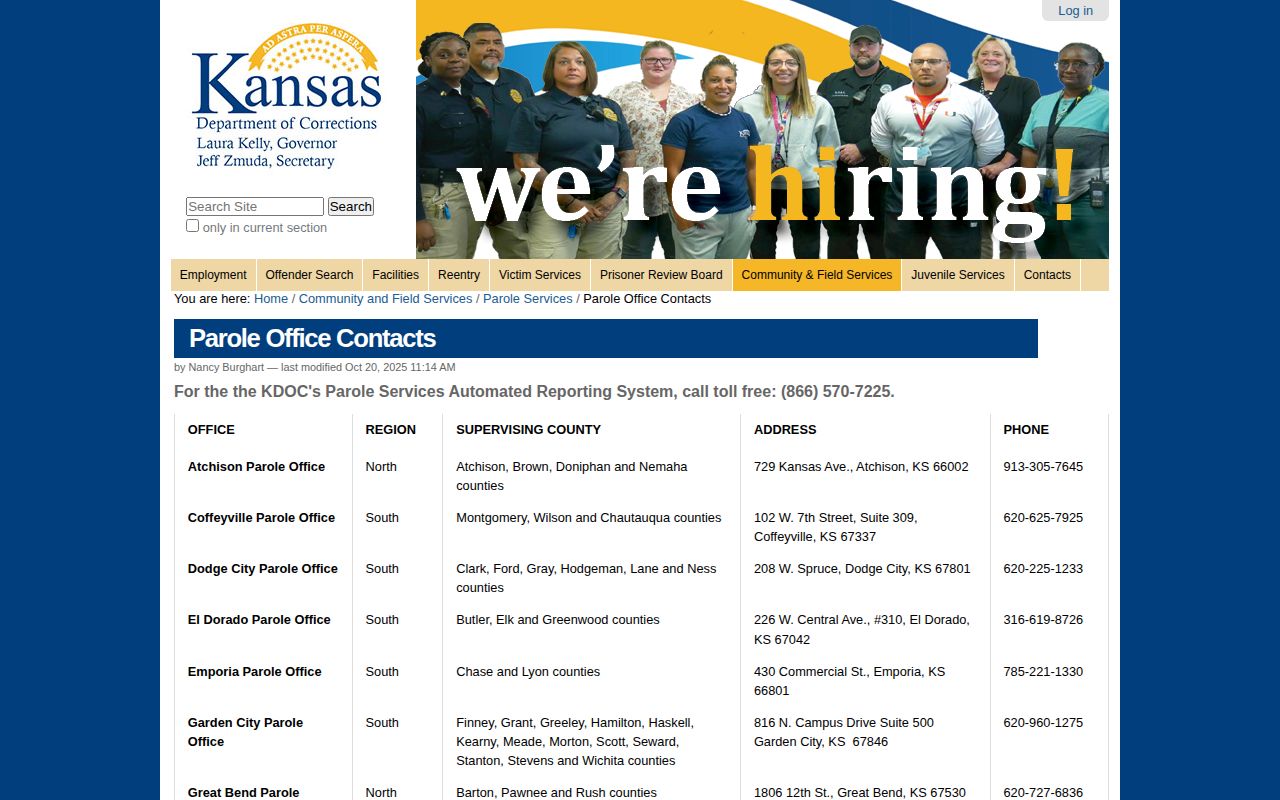
Its Logan-area listing supports direct office verification without turning a residence address into an assumed assignment.
Logan Supervision and Absconders
KASPER has a separate parole absconder search that can be narrowed to Logan County as the location before absconding. Its navigation also reaches a community-corrections absconder search. These lists concern people alleged to have stopped complying after release into supervision. They are not recent-release lists, new-conviction records, or proof of present physical custody.
Status can change between KDOC’s working-day updates. No one should try to arrest, locate, or confront a person based on a web result. Supply information to local law enforcement or KDOC Enforcement, Apprehensions and Investigations at 785-414-7755. The Parole Services Automated Reporting System is also not a public locator. Its credentials and phone channel are for assigned people who report through that system.
The official Logan-selectable absconder search is shown below.
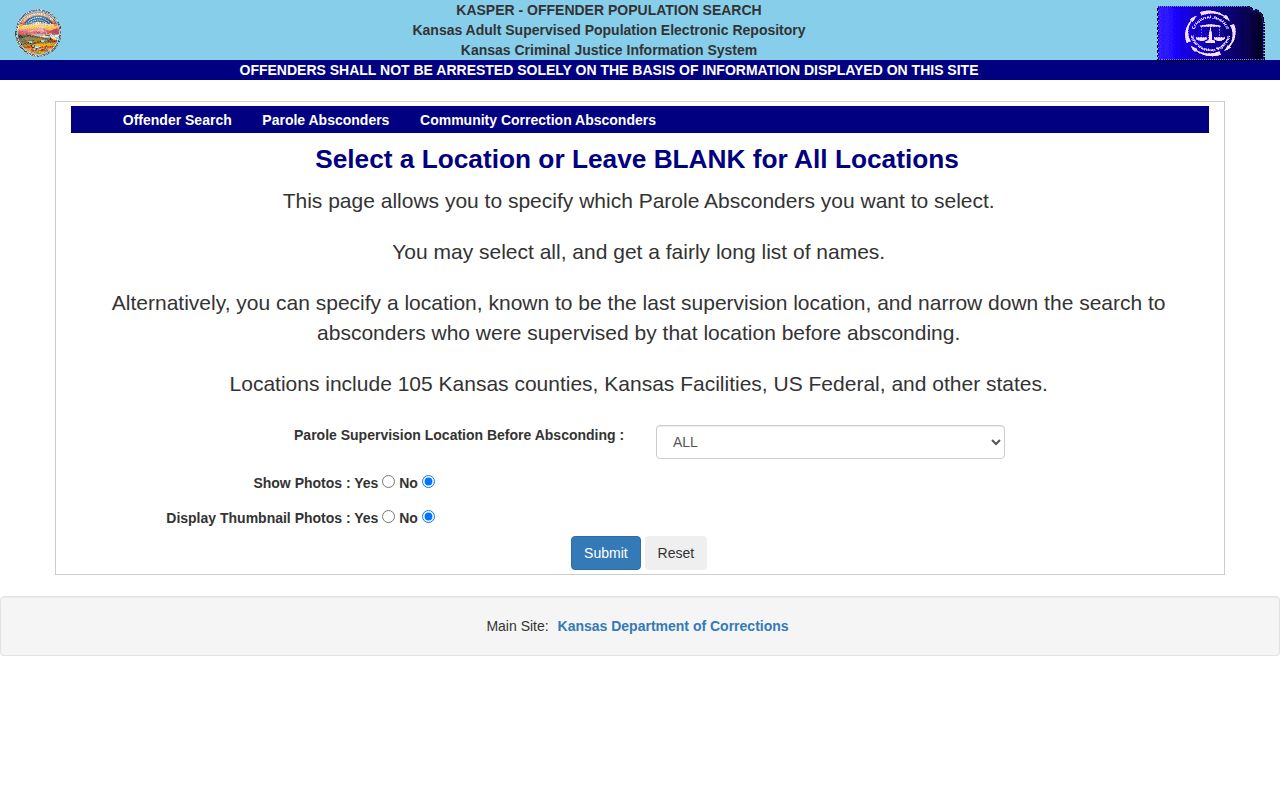
The county filter identifies the reported supervision connection, while the warning preserves the difference between a public listing and current custody.
Logan County Supervision Discharge
Supervision ends through an official discharge, not simply because a name vanishes from a jail roster or no new court event appears. KASPER may retain a state correctional history after discharge. The underlying KDOC discharge record supplies the stronger agency proof. Court probation ends through the district court’s order or a record from the responsible supervision authority. The Logan County release-record path explains how to request an existing release, movement, or discharge document from the agency that created it.
Kansas law also makes discharge dates relevant to some expungement waiting periods. Expungement is a court process that limits ordinary public access to an eligible record. It is not automatic, and the waiting period varies by the judgment. K.S.A. 21-6614 uses satisfaction or discharge from probation, community corrections, parole, postrelease supervision, conditional release, or a suspended sentence in several timing rules. The individual judgment and current statute control.
Warrants After Logan Release
Thomas County publishes a searchable warrant list with name, warrant number, charge, bond, date, age, sex, and race. It may reveal a separate outstanding process after a person leaves the serving jail’s roster. A warrant is not proof that the person is now in custody, that a release occurred, or that parole or probation is active. It also does not replace the Logan County court file or KASPER.
Match the warrant to the right person and agency before drawing a conclusion. Then use the court that issued it and the appropriate law-enforcement contact. The warrant list is a legal-process lead, while a jail release sheet records the exit from physical custody and a supervision record identifies post-release authority.
The Thomas County warrant channel appears below.
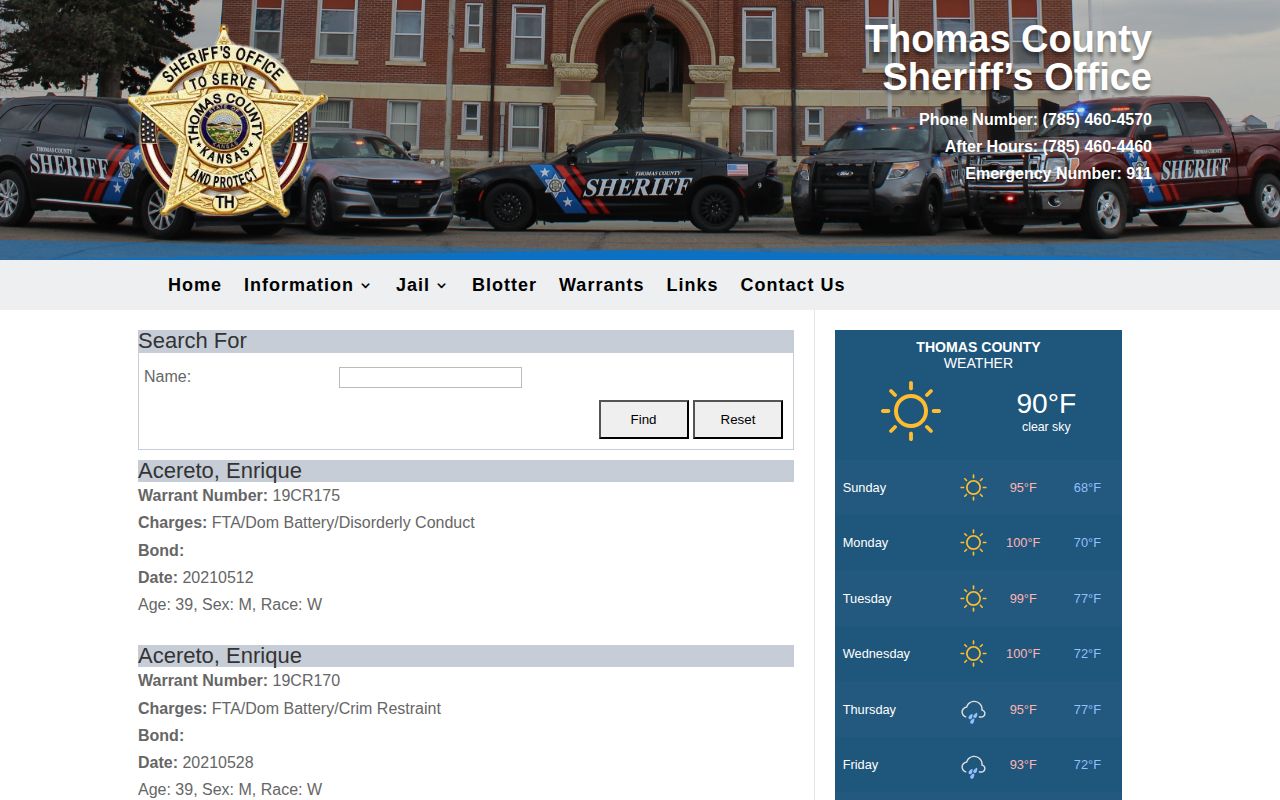
Its distinct fields reinforce why warrant, custody, release, and supervision must be checked as separate records.
Logan Probation Data Gap
KDOC states that community-corrections probation events after April 21, 2021 cannot presently display during its data-modernization transition. That limitation is especially important in Logan County. A missing recent probation event in KASPER does not establish that the person lacks supervision or has been discharged. Check the Logan County court docket and contact Northwest Kansas Community Corrections with the case details.
Use full name, date of birth when known, court case number, sentencing date, and KDOC number if one exists. Ask for the appropriate public status or record rather than private case-management details. When an online status and an office response differ, obtain the dated order or agency record that created the change.
Logan Parole Hearing Records
The Kansas Prisoner Review Board handles discretionary parole for people whose sentence makes them eligible. Its public comment calendar posts dated sessions, and the monthly offender list identifies people scheduled for hearings in the following month, often with a possible-release month after that. County of conviction does not necessarily show where a person lives or returns.
A scheduled hearing is not a release grant. The Board may grant, deny, pass, defer, rescind, revoke, or take another action allowed by the sentence and proceeding. No authoritative permanent person-by-person decision search was verified. For an individual result, check KASPER after the hearing, contact the Board, or request the public decision record under the Kansas Open Records Act.
The official public-comment schedule is pictured below.

The schedule starts the inquiry, while the later KASPER status and KDOC release record confirm whether release actually occurred.
Request Logan Supervision Records
A public lookup may not resolve the assigned office, discharge date, or recent probation event. Request the specific existing record from the agency that created it. For court probation, identify the Logan County case and seek the sentencing, modification, revocation, or discharge order. For KDOC supervision, identify the KDOC number and request the relevant assignment, release, movement, or discharge record.
Keep the request narrow. Give the full name, date of birth if known, case or KDOC number, approximate dates, and preferred electronic format. Ask for a fee estimate. KORA requires agency action by the end of the third business day, though the response may explain a delay, seek clarification, redirect the request, or cite a legal basis for withholding.
A supervision office may protect private case-management details even when a basic public status is available. Ask for segregable open portions and the statute supporting any redaction. The goal is to document status and the responsible agency, not to obtain details unrelated to the release or supervision event.