
Logan Projected Versus Actual Release
KASPER, the Kansas Adult Supervised Population Electronic Repository, uses the exact field label “Anticipated release date.” It is KDOC’s current public estimate based on sentence computation. It is not a promised day or an exact gate time. Credits, forfeitures, court amendments, detainers, and later calculations may change it. The actual release or transfer appears in KDOC movement and supervision history and, when needed, the underlying agency record.
A Logan or Thomas County pretrial booking works differently. Someone awaiting court action has no state-prison sentence to compute. Bond, release on recognizance, dismissal, a court order, another hold, or transfer may determine the exit. No Logan or Thomas local good-time policy, weekend-release rule, fixed release hour, or bond-processing time was found. Call the actual housing jail and request its release or movement sheet.
Find Logan Inmate Release Dates
Begin with last known custody, not the arrest county alone. Thomas County Jail’s roster has shown people arrested by Logan County Sheriff and Oakley Police. A person may also remain local, go to another jail, enter KDOC custody after sentencing, or transfer to another authority. The Logan County release search maps those routes.
- Call Logan County Sheriff at 785-671-3288 or Oakley Police at 785-671-3219 and ask where the person was transported.
- For a current county-jail booking, search the Thomas roster and call the jail at 785-460-4570. Ask whether a court order, bond, sentence, or hold supplies a date.
- For KDOC custody, open KASPER, accept the disclaimer, and search by KDOC number or identity fields.
- Match name, birth information, photograph, conviction county, case number, location, and movements. Then read the exact “Anticipated release date” field.
- Near the displayed date, confirm with the listed office or KDOC Sentence Computation at 785-296-3317.
KASPER covers people sentenced to the Secretary of Corrections since 1980 who are incarcerated, under post-incarceration supervision, or discharged. It does not cover every Kansas justice contact. A Logan County bond-out who never entered state custody may have no relevant KASPER record.
The official KASPER entry is shown below.
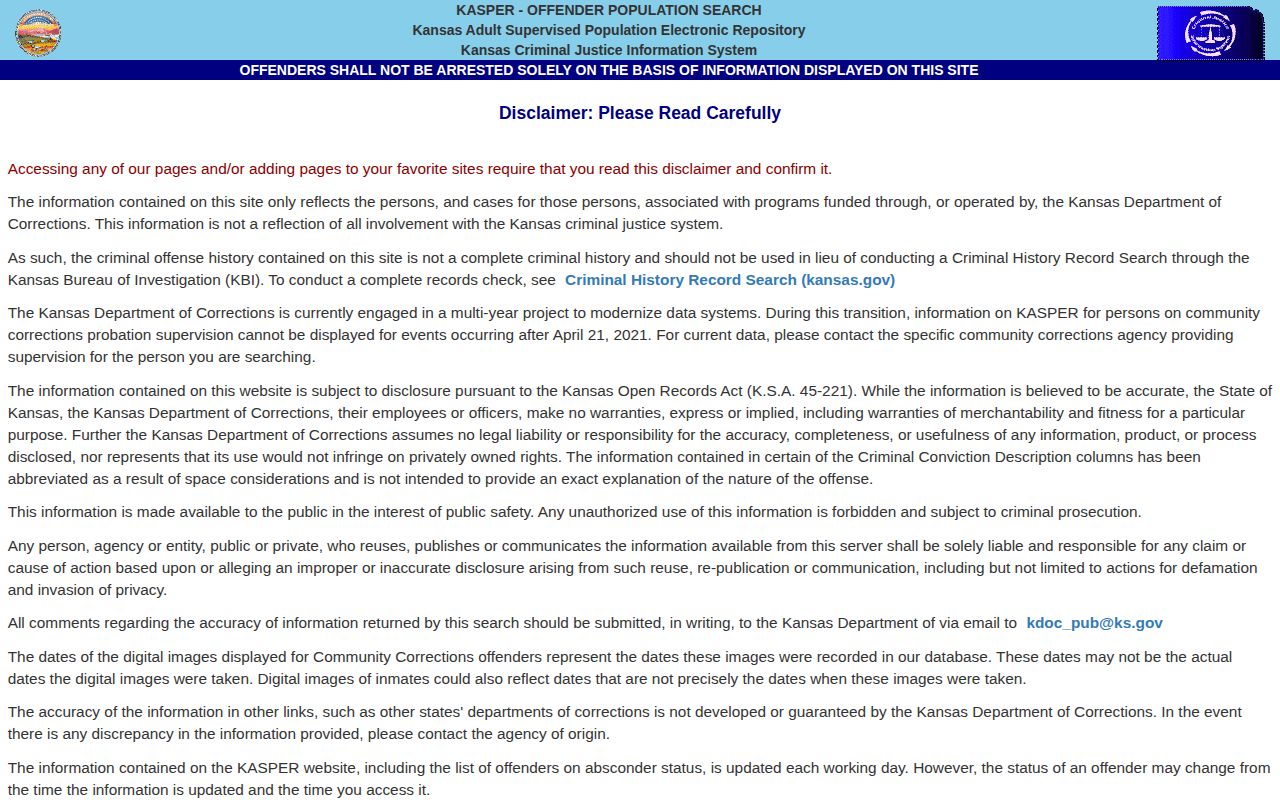
The disclaimer and identity search are the start; the matched offender detail supplies the state status and anticipated date.
Kansas Good-Time Release Calculation
For Kansas sentencing-guidelines crimes committed on or after July 1, 1993, K.S.A. 21-6821 generally limits good time subtracted from the prison portion to 15 percent. This produces the common shorthand that a person may serve about 85 percent. Kansas does not always require exactly 85 percent. The statute allows up to 20 percent for specified lower-severity nondrug and drug categories committed during the dates it identifies.
Good time is earned and may be forfeited under KDOC rules. It is not an automatic discount awarded in full at sentencing. The same statute permits up to 120 days of program credit for some eligible sentences after successful completion of qualifying education, training, treatment, or another risk-reducing program. Eligibility turns on offense date and severity. The maximum is not a promise that the person will earn or retain it.
For crimes before July 1, 1993, K.S.A. 22-3725 provides an old-law good-time structure tied to parole or conditional release. Off-grid and life sentences have special rules under K.S.A. 22-3717. A simple percentage cannot lawfully resolve every sentence.
The Kansas good-time statute appears below.
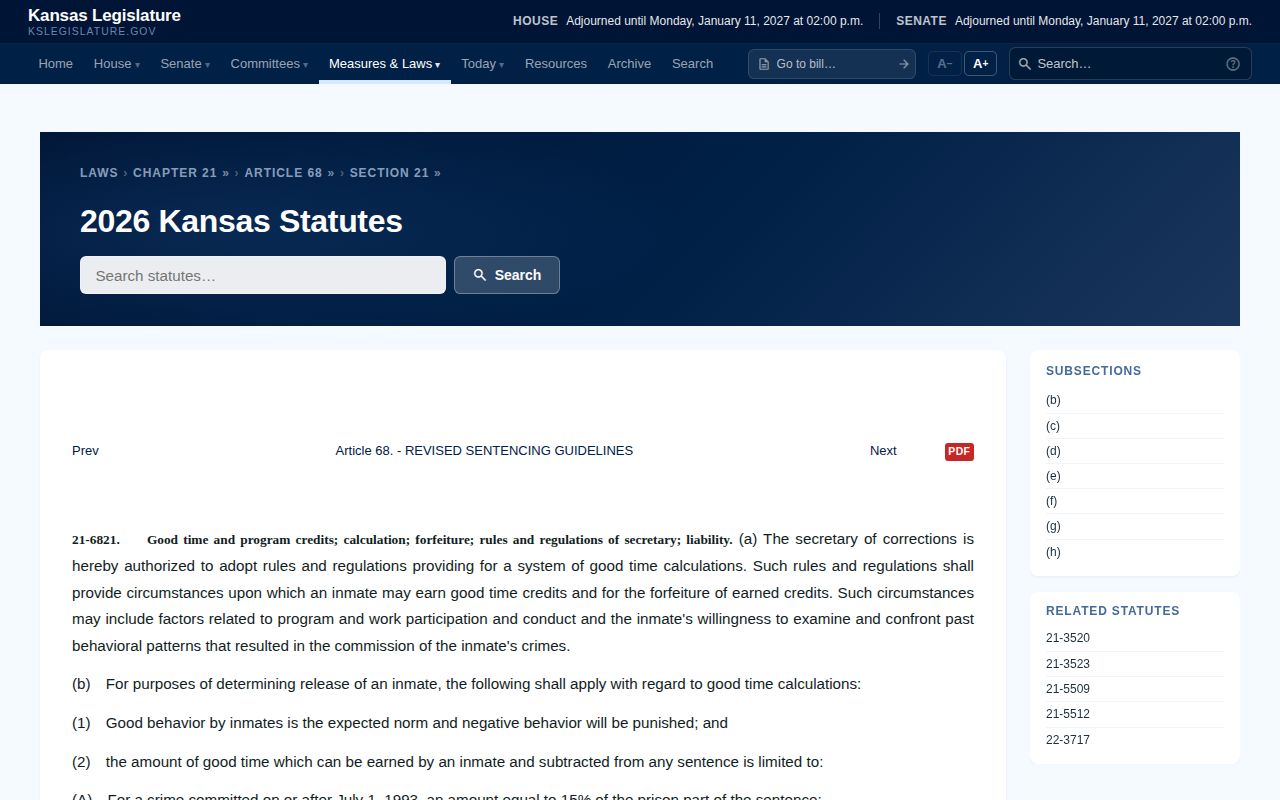
Its category and date limits show why a Logan County release estimate must come from KDOC’s individual sentence computation.
Why Logan Release Dates Change
KDOC starts with the journal entry and controlling prison term, applies jail credit and concurrent or consecutive sentence rules, identifies the law tied to the offense date, then applies credits actually earned and retained. Later events can move the public estimate. A detainer is a request or legal basis for another authority to take custody; it can prevent a person from walking into the community even when one agency’s term ends.
| Change | Effect on the date or outcome | Confirm with |
|---|---|---|
| Good-time earning or loss | Retained credit can advance the estimate; forfeiture can move it later | KDOC computation and disciplinary history |
| Program credit | An eligible completed program may reduce the term within statutory limits | KDOC record and K.S.A. 21-6821 |
| Court amendment | A corrected sentence or jail-credit order changes the controlling inputs | Journal entry and KDOC recalculation |
| Other hold | The person may transfer instead of entering the community | Release or transfer record from each agency |
| Parole decision | A hearing date or possible-release month may lead to grant, denial, pass, or deferral | Prisoner Review Board and later KASPER status |
Sentence aggregation, restoration of credits, revocation, and administrative correction may also matter. KASPER warns that status can change after its working-day update. Capture the displayed date as a dated observation, not a permanent promise.
Confirm Logan County Release
Use the channel that covers the custodian. KASPER covers KDOC prisons and post-incarceration supervision. Kansas VINE covers participating county jails and expressly excludes KDOC prison residents. The VINELink Release Check can provide a prospective alert for release, transfer, or escape while a person is in county-jail custody. A transfer alert does not mean release to the community.
For Thomas County Jail, call for the release or transfer disposition and exact date. Ask for the booking sheet, release sheet, movement log, and transfer document when the event is disputed or historical. The Logan County District Court record can explain the bond, dismissal, sentence, probation, or commitment, but a court order should not be treated as the jail’s exact exit time unless it records that fact.
A missing current-roster entry is only a lead. It may mean bond, time served, court-ordered release, transfer to KDOC, another county, federal or immigration pickup, escape, or death. The custodian’s movement record distinguishes those outcomes.
Logan County Jail Date Limits
No official Logan or Thomas County future-release calendar was located. Thomas County offers a current roster and an intake report, not a release schedule. The roster displays booking data but no documented release date, retention period, or update cadence. Comparing two roster views cannot prove when or why a person left.
A county sentence can involve court-awarded jail credit, while a pretrial release may turn on bond or another judicial act. Do not apply the state-prison 85-percent shorthand to a local booking. Ask the housing jail which existing record reflects the expected event, then use the actual release sheet after the person leaves.
Logan State Sentence Inputs
A reliable KDOC estimate begins with the journal entry, which is the court’s formal sentencing record. The controlling prison term, jail-time credit, and concurrent or consecutive structure must be identified first. Concurrent terms run together; consecutive terms run one after another. KDOC then applies the law in force on the offense date and decides whether the sentence falls under guidelines rules, old-law indeterminate rules, an off-grid provision, or another special category.
Only credits legally available to that sentence enter the calculation. KDOC subtracts credit actually earned and retained, not the largest credit someone might earn in the future. Forfeiture and restoration can change the total. A later journal entry can correct the sentence or jail credit. Another agency’s detainer can also change the outcome from community release to transfer, even if the anticipated KDOC date itself arrives.
Parole eligibility adds a different question. The Kansas Prisoner Review Board’s public-comment lists may show a hearing and possible-release month for eligible people, but neither is a grant. Outcomes can include grant, denial, pass, deferral, rescission, or another action allowed by the sentence. Check the later KASPER status and request the Board record when the outcome must be documented.
Request Logan Release-Date Records
When the online date is missing or disputed, request an existing record from the correct custodian. For KDOC, identify the sentence computation, movement history, release document, discharge record, or detainer information sought. Include full name, KDOC number, Logan County case number, date of birth if known, and a useful date range. Ask for electronic copies and a fee estimate before staff performs substantial work.
For Thomas County Jail, request the booking sheet, release sheet, movement log, and any transfer document together. That set can identify when the jail stopped holding the person and whether the exit led to the community or another agency. Logan County may retain the arrest report while Thomas retains the jail record. Call first when the custodian is unclear.
Under K.S.A. 45-218, an agency must act on a Kansas Open Records Act request by the end of the third business day. The response may provide records, ask for clarification, explain a delay, redirect the request, or cite a denial. Reasonable actual costs and advance payment may apply. No local sheriff release-record fee was published, so request an estimate rather than borrowing the district court’s separate copy schedule.
After Logan Release Dates Arrive
A date does not by itself describe where the person went. A bond release returns a county-jail detainee to the community while the case remains open. A court-ordered release can also leave conditions in force. A transfer date means the first agency stopped holding the person, but another jail, KDOC, a federal authority, or immigration custody may have taken control. A KDOC release to parole or postrelease supervision means the person left the prison facility while state authority continued.
Use the destination and release type with the date. For a Thomas County exit, ask whether the disposition was bond, recognizance, time served, court order, or transfer. For a KDOC event, read the status and supervising office. If a federal matter is plausible, BOP covers sentenced federal prisoners, while the federal docket and U.S. Marshals Service are stronger routes for pretrial custody. ICE’s locator can cover current detainees and some people released from ICE custody within its limited recent period.
These systems do not share one universal release calendar. A Thomas roster disappearance, a VINE custody-change alert, and a KASPER anticipated date each answer a narrower question. Build the final conclusion from the last custodian’s dated event and the next destination. That prevents an agency transfer from being reported as freedom from all custody.
Record the time of each lookup. A later agency update can change a public status, so dated notes help explain why two sound checks produced different results.