
KDOC Releases for Logan County
A Logan County case can move from a local arrest to Thomas County Jail or another housing jail, then into KDOC after sentencing. Once KDOC accepts the person, KASPER becomes the main public state-corrections channel. It may show incarceration, parole, postrelease supervision, conditional release, compact supervision, absconder status, or discharge. The county roster documents the earlier jail stay. It cannot prove a later state-prison release.
Leaving a prison building does not always end custody. Parole and postrelease supervision place the person in the community under rules. A transfer moves custody to another institution or authority. Discharge ends the KDOC sentence and supervision relationship, subject to the repository’s update warning. Obtain the movement, release, or discharge record when the exact event matters.
| KASPER status | What it means |
|---|---|
| Incarcerated | The person remains in a KDOC facility or placement shown by the state record. |
| Parole or postrelease | The person has left prison but remains under supervision. |
| Absconder | The person is alleged to have stopped complying; it is not discharge. |
| Discharged | The KDOC sentence and supervision relationship is recorded as ended. |
Confirm a KDOC Logan Release
Open KASPER and accept its disclaimer. A KDOC number is the strongest identifier. Otherwise compare full name, birth data, photograph, conviction information, county and case number, physical description, current location, and facility movements. Name alone is not enough.
- Confirm that the Logan County person was committed to KDOC. A county bond-out may have no relevant state record.
- Search KASPER and match several identity and case fields.
- Read the current status, movement dates, supervision office, and “Anticipated release date” if one appears.
- For a completed event, distinguish release to supervision from discharge.
- Call the listed office or Sentence Computation at 785-296-3317 when the date is near or disputed.
KASPER is updated each working day. It is not a complete criminal history, and status can change after the last update. The Logan County released-inmate workflow supplies the jail and court paths when KDOC is not the correct custodian.
The official KASPER search is pictured below.
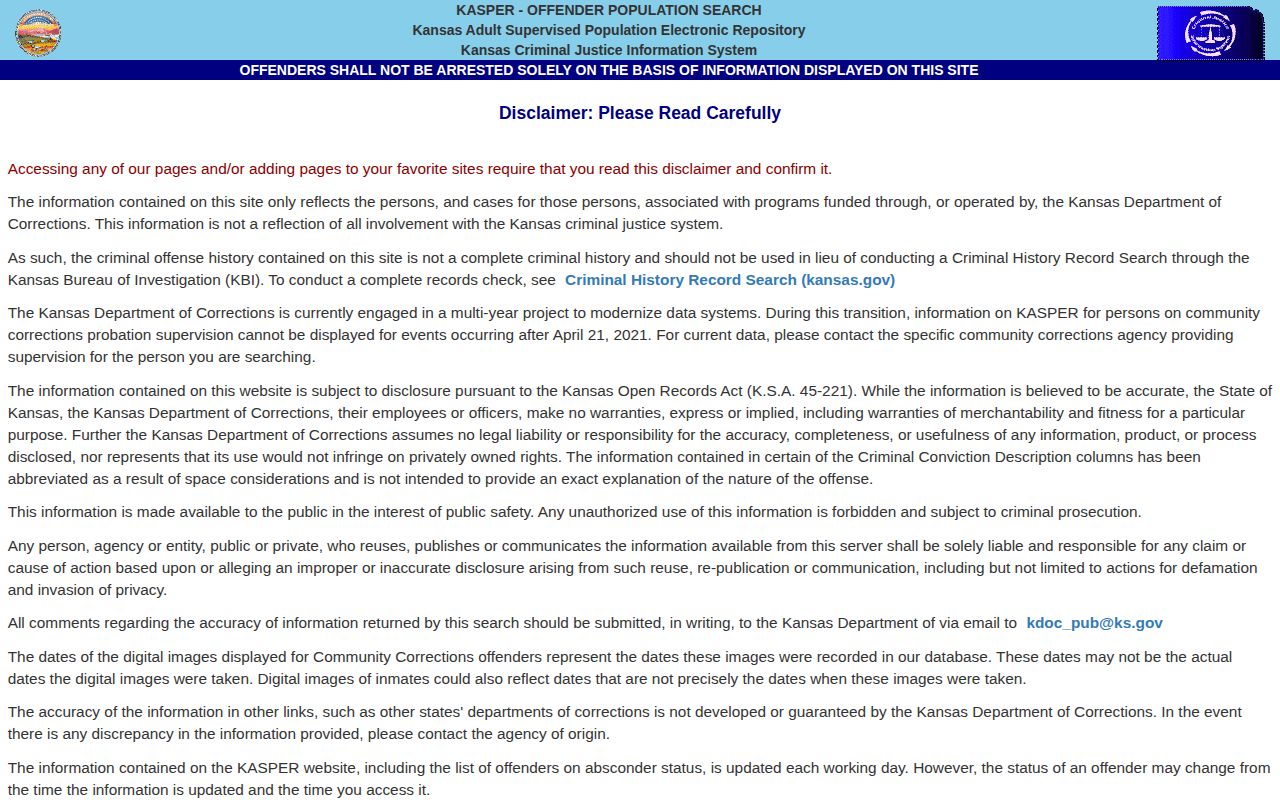
The state search remains useful after discharge because KDOC says it covers sentenced people since 1980 within the listed custody and supervision categories.
KDOC Release Records and Contact
A KASPER printout is a public search result. It is not the same as the underlying sentence computation, movement log, release document, discharge record, or correctional photograph. Ask KDOC’s designated records custodian for the specific existing record and give the person’s full name, KDOC number, Logan County case number, and date range. Request electronic copies and a fee estimate.
KDOC Sentence Computation UnitStatewide Kansas corrections contact
785-296-3317
kdoc_pub@ks.gov for KASPER comments or corrections
KORA, the Kansas Open Records Act, requires a response by the end of the third business day, but that response may provide records, ask for clarification, explain a delay, redirect the requester, or cite a denial. It does not promise delivery in three days. Fees may reflect actual search, review, copying, and redaction costs, and prepayment may be required.
KDOC Is Not Logan Jail
Kansas Department of Corrections operates the state prison and post-incarceration supervision system. No KDOC prison was found inside Logan County. The department appears in the Logan facility map as a transfer and jurisdiction channel, not as the county jail. Thomas County Jail has provided direct roster evidence of housing some Logan Sheriff and Oakley Police arrests.
A person leaving Thomas County for KDOC has exited the county jail but has not entered the community. The Thomas movement or transfer record documents the handoff. KASPER then documents state custody. When the person later leaves prison, the state history and release record identify supervision or discharge.
KDOC Anticipated Release Date
KASPER’s exact term is “Anticipated release date.” It is a sentence-computation estimate, not a confirmed release. Kansas law varies by offense date, sentence type, severity, credits, and court orders. For many guidelines crimes, K.S.A. 21-6821 generally caps good time at 15 percent, but specified categories may allow different limits. Program credit may also be available for eligible sentences.
Discipline can cause forfeiture. Court corrections, jail credit, concurrent or consecutive terms, detainers, restorations, and administrative recalculation may also move the date. Off-grid, life, and old-law sentences have distinct rules. Do not calculate a Logan County person’s legal date from a simple percentage.
The Kansas release framework appears below.
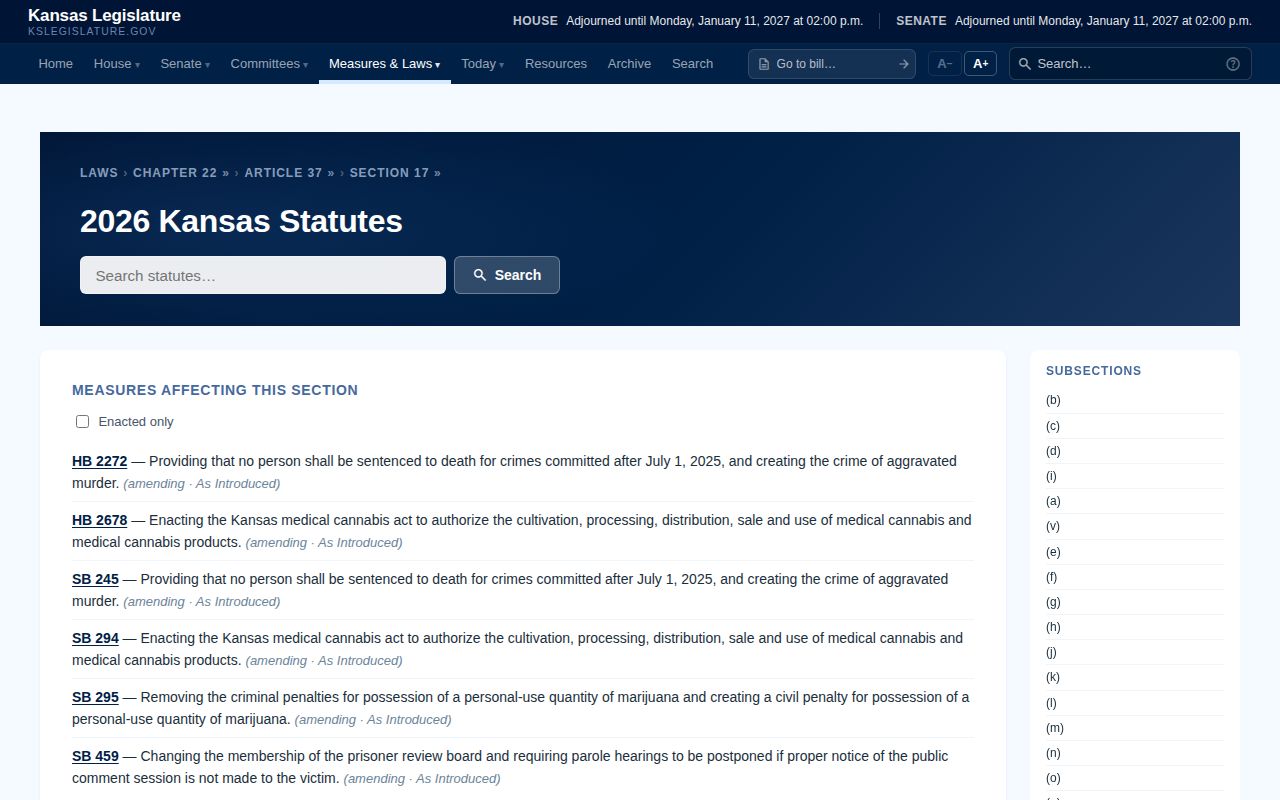
The statute’s sentence-specific provisions explain why KASPER and KDOC computation, not a generic formula, control the estimate.
Logan KDOC Supervision Routes
KDOC’s current contact list associates Logan County with Northwest Kansas Community Corrections at 1011 Fort Street, Hays, 785-625-9192. Confirm the assigned office in KASPER because placement and interstate compact rules can alter where a person reports. Court probation and KDOC parole remain separate legal statuses.
KDOC also states that community-corrections probation events after April 21, 2021 cannot presently display during a data-modernization transition. A missing recent event does not prove no supervision exists. Use the Logan case docket and the Hays contact for the proper public verification.
KDOC Release Search Fields
KDOC says KASPER can provide name, registration number, birth and physical information, photograph and markings, convictions, county and case number, anticipated release date, current location, facility movements and dates, supervising parole office, custody or supervision level, and release to parole, conditional release, postrelease, or compact status. Institutional disciplinary findings may also appear. These details make it possible to distinguish two people with similar names and trace a Logan conviction into state custody.
The photograph is a KDOC identification image, not automatically the Logan or Thomas booking photograph. Likewise, the anticipated date applies to state sentence computation. It does not estimate how long a local jail needs to process bond. Label each field by its originating system before relying on it.
KASPER does not include every justice contact. KDOC also says people sent to Kansas under the interstate compact are not included in the same way. A missing record may therefore require the court, housing jail, or assigned supervision office. It is not proof that no custody or release event occurred.
KDOC Release Record Scope
A state release record should answer the exact agency event. Useful items include the admission or commitment, facility movements, sentence computation, anticipated date history, actual release date, release type, destination or supervising office, and discharge date when applicable. Ask for only the existing records needed. A focused date range and KDOC number reduce mistaken identity and unnecessary search cost.
K.S.A. 45-218 directs an agency that is not the custodian to identify the known custodian and location. KORA also allows reasonable fees tied to actual work and advance payment. Exemptions may protect security-sensitive, medical, investigative, or other restricted details. Ask the agency to release segregable open portions and cite the legal basis for each withholding.
KASPER’s offense history is not a complete criminal history. It should be used to verify corrections status, movement, supervision, and discharge for a matched person. A dated screenshot shows what the repository displayed then, while the source record supplies stronger proof of a disputed event.
Corroborate Logan KDOC Releases
The Logan County District Court file explains why a person entered state custody. A journal entry may show conviction, controlling sentence, jail credit, and commitment to the Secretary of Corrections. Later filings can correct the sentence or document revocation. KASPER then shows how KDOC implemented custody and supervision. Neither record should be stretched beyond its role.
A court order authorizing or setting a legal event is not always the exact time someone left a facility. Processing, another hold, or transfer arrangements may intervene. Conversely, a KDOC movement entry documents agency action but may not explain the complete judicial basis. Compare case number, conviction county, sentence, and dates to confirm that both sources concern the same Logan County person.
If a public filing is not online, the 15th Judicial District permits courthouse access and written requests. Sealed, expunged, juvenile, and other protected matters are not available through ordinary public access. A missing court result therefore cannot prove that no state custody or release occurred. Ask the clerk about the appropriate public route without attempting to reconstruct a restricted file from stale copies.
For a person who has left KDOC supervision, the discharge date can matter to later court processes. KASPER names may remain after discharge, and KDOC says a record can disappear after an overturned conviction, expungement, or executive clemency. Obtain the court or agency record rather than guessing why an older state entry changed.